
Alpaca socks
Breathable and warm alpaca socks - a favorite of our customers for over ten years
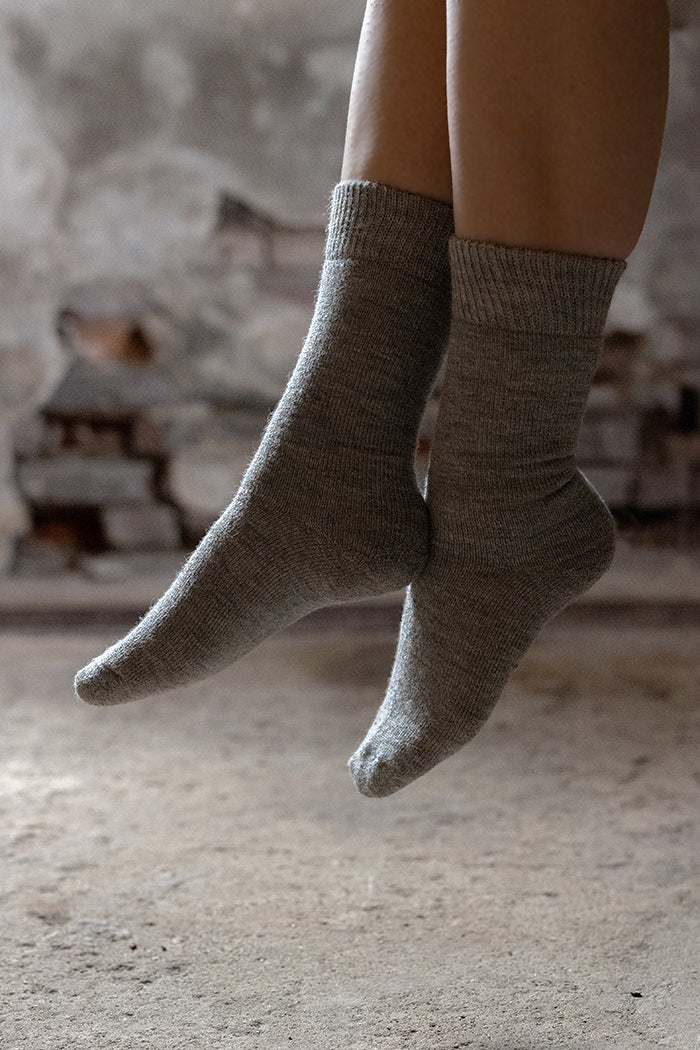
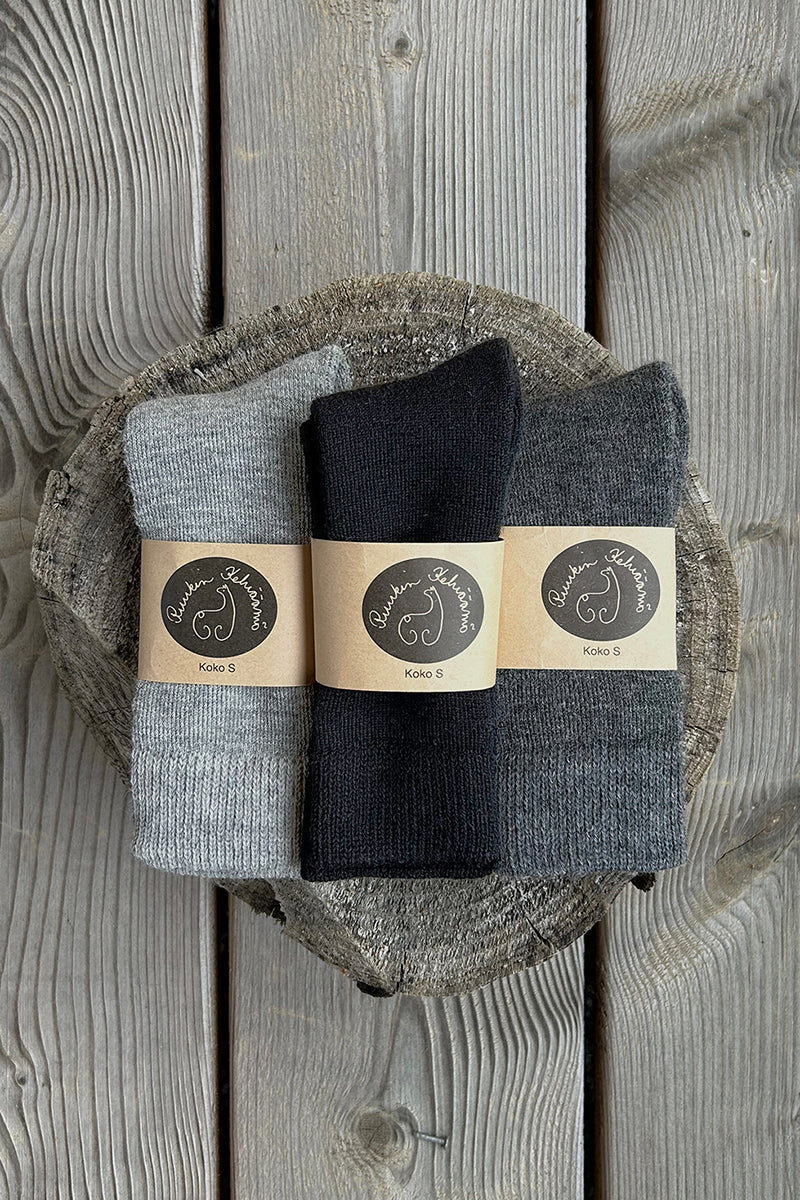
High-quality wool socks made of alpaca wool are suitable for both exercise and home use. Use the socks for hiking, sports, everyday use and as sleep socks, in all seasons. Your toes will not freeze in these socks. Alpaca socks keep your feet warm even when wet. Ruukkin Kehräämö's alpaca socks are not tight and do not cause mechanical irritation. For this reason, the socks are also suitable for diabetics, rheumatists and swollen feet. Alpaca wool is also hypoallergenic. The sock material is Superfine Alpaca fiber, to which synthetic fiber has been added to improve durability.
Material:
80% Superfine Alpaca
15% polyamide
5% elastane
Alpaca polyamide yarn is made in Peru. Elastane is added to the yarn during the knitting stage of the sock. The socks are manufactured by Sukkamestarit Oy in Finland.
Properties of alpaca wool
Alpaca wool is a valued natural fiber that is suitable for year-round use:
- Excellent thermal insulation
- Breathable and temperature-regulating
- Naturally moisture and dirt-repellent
- Effectively wicks moisture away from the skin
- Hypoallergenic and antibacterial
- Does not bind odors
- Lightweight but durable
- Softer than traditional wool
Country of manufacture: Finland
The delivery fee within the country is €10. Orders over €150 are delivered free of charge. The delivery fee to other parts of the world is €30. We will ship all orders within 1−6 business days after the order is placed. Read the detailed shipping policies by opening the link.
The customer has a 14-day exchange and return policy. Read the detailed return policies by opening the link.
Notification of the return must be made in advance using the return form or by email to posti@ruukinkehraamo.fi.
The customer is responsible for the costs associated with exchanges and returns unless otherwise agreed.
Alpaca fibre is warm, light, and pleasantly soft. Alpaca fibres are classified and named according to their coarseness. The finer the alpaca fibre, the more refined its properties become when spun into yarn. Superfine alpaca is most commonly used in the clothing industry. Finer (=thinner) fibres than superfine alpaca are Baby alpaca and Royal alpaca. Royal alpaca is the finest fibre available for industrial-scale clothing production.
Alpaca fibre has exceptionally good thermoregulatory capabilities. Thanks to the crimped structure of the fibre, air pockets form between the fibres, acting as insulation. Alpaca fibre repels water and dirt, and does not absorb odours. Hypoallergenic and antibacterial, the fibre is also well-suited for those with sensitive skin.
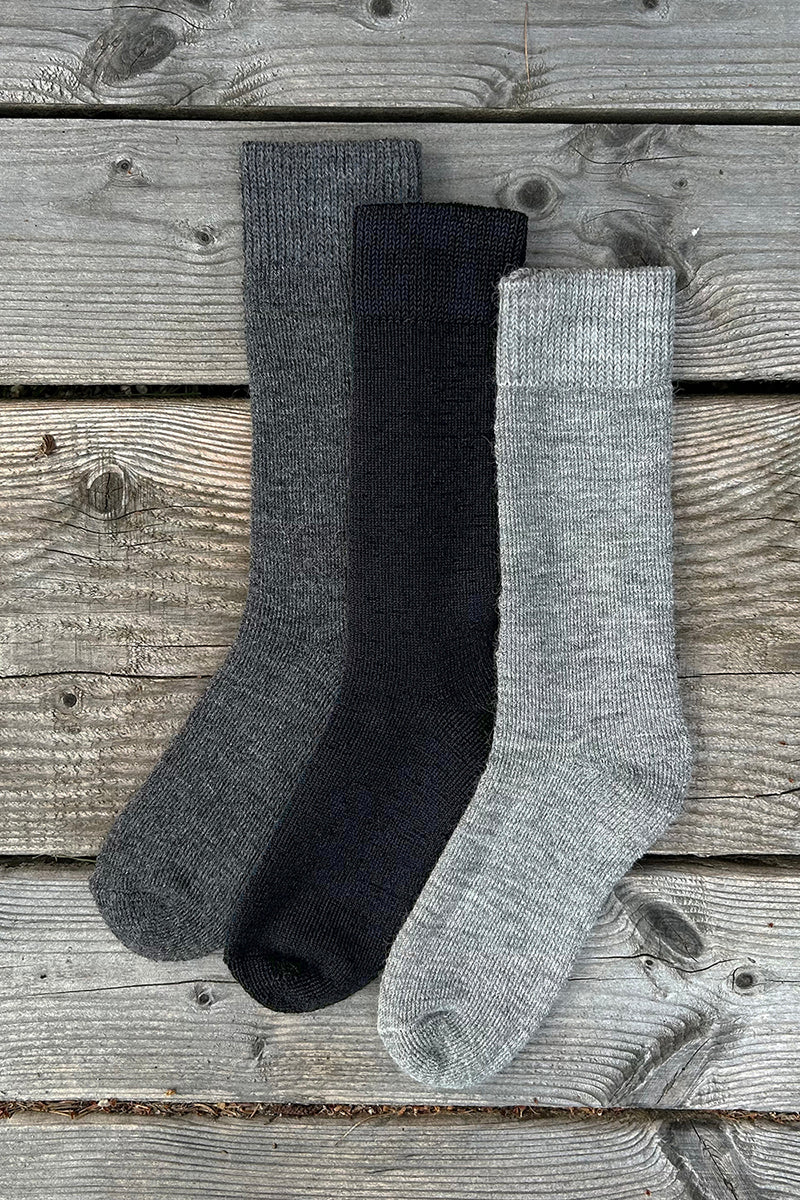
The colours used in our collection mimic the natural shades of alpaca wool. The alpaca fibre used by Ruukin Kehräämö is only dyed if the desired colour is not available undyed. Dyeing is always done using safe GOTS-certified methods. The alpaca yarns used by Ruukin Kehräämö have OEKO-TEX Standard 100 and Fair Trade Peru certifications. Superfine alpaca fibre is spun into yarn by Michell Group in Peru.
The socks are best freshened by airing and only need to be washed rarely. Wash by hand with wool detergent or on the hand wash program in the washing machine, at a maximum temperature of 30°C. Avoid spinning or using fabric softener, and dry your socks flat, for example by squeezing them inside a towel, never in a dryer. Store your socks folded rather than tightly rolled.
1. Why doesn't our collection include any colorful knitwear at all?
We want to follow nature's own color palette in our collection. All the shades we use replicate alpaca colors found in nature, of which there are nearly thirty in total. The Alpaca Royal fiber used by Ruukki Spinning Mill is only dyed if that particular color is not available undyed. Dyeing is always done under supervision, using the safest and most responsible REACH- and GOTS-certified methods.
Alpaca Royal -fiber does not require any additional chemical treatments. All chemical processes wear down fibers and damage their surface structure. The less the fiber has been treated, the more its natural properties are transferred directly to the garment.
When knitwear reaches the end of its lifecycle, the fiber lives on. Alpaca fiber is a 100% biodegradable natural product. Knitwear can also be shredded back into fibers and recycled for reuse.
2. Why do our products have a delivery fee?
We want you to avoid making a hasty purchase decision and to be certain of your choice when ordering a product. In Finland, up to 50% of online orders are returned. A shipping fee has been shown to significantly reduce the number of returns. On average, for clothing sold online, the largest emissions come from the product itself (~83%), while transportation accounts for 14% of emissions. If the product is returned, the transport emissions are doubled.
We therefore want to act responsibly toward both our customers and the environment. When you buy less, more thoughtfully and of better quality, the environment and your wallet will thank you. Read more about how transportation affects an e-commerce product's emissions.
3. Why don't we have discount campaigns?
We don't support fast fashion or rushed purchase decisions. FOMO (Fear of missing out) is a commonly used marketing tactic to get customers to buy products they may not need. By limiting an offer to a specific time, consumers are encouraged to make impulsive purchases. Instead, we want you to be satisfied with the purchases you make from us and to use our products for a long time. You can always trust that a product is the same price with us whether you're shopping on Black Friday or on a regular Sunday morning.
3. How can we guarantee that yarn from Peru is produced responsibly?
In the Peruvian highlands, alpaca farming is the main source of livelihood. Up to 85% of the indigenous population's income is generated from selling alpaca wool. By buying wool from specific farms, we can ensure that the farmers receive fair compensation for their work. Alpacas play an important role in breaking the cycle of poverty.
Ruukin Kehräämö uses only high-quality and ethically produced, RAS-certified (Responsible Alpaca Standard) alpaca wool. Breeders from Peruvian indigenous communities tend their small herds with respect for nature. The organization we support Quechua Benefit auttaa indigenous people care for both the well-being of their alpacas and their families. For each yarn batch arriving at Ruukin Kehräämö, alpaca fleeces are collected separately from local small farms. Every fiber can be traced back to the farm and even to the individual animal. Breeders receive double the price for Alpaca Royal fiber compared with coarser fibers.
4. How can we guarantee that neither angora rabbits nor alpacas suffer during the harvesting of their wool?
Alpacas and angora rabbits are wool-producing animals. They have been bred to produce wool, like merino sheep. Leaving a wool-producing animal unshorn is harmful to the animal, because the wool does not stop growing at a certain length; instead, long, matted wool makes it difficult for the animal to move and worsens hygiene.
We purchase angora rabbit wool only from domestic farms where combing is done with the animals' welfare in mind and in a stress-free manner. Voit katsoa yhteistyökumppanimme Villiniityn kerintävideon ja tutustua angorakaneihin blogitekstissämme.
The alpaca wool we use in our craft yarns comes mainly from domestic farms where the alpacas are shorn professionally and without pain. We buy the black alpaca fiber from a Dutch farm Tienda from Molino's alpaca farm. In Peru, the indigenous people have long traditions in both caring for alpacas and pain-free shearing.
Choose options
Klikkaa logoa ja lue mitä merkki käytännössä tarkoittaa.



Viimeksi katsotut tuotteet:
Let customers speak for us

Luottoneule syksyyn. Ihana, ei liian paksu. Voi pitää housujen ja hameen kanssa. Tilasin heti pooloneuleen. Nyt harkinnassa hame tai joggerit.
Luottoneule syksyyn. Ihana, ei liian paksu. Voi pitää housujen ja hameen kanssa. Tilasin heti pooloneuleen. Nyt harkinnassa hame tai joggerit.

Huivi on kuin rakkaimman pehmeä syleily.
Hyvä tuote ja mahtavaa asikaspalvelua👍🏼

Vasta kaksi kertaa shampoolla pessyt ja heti on vahvemman tuntuinen hius. Ensivaikutelma erinomainen.

Kauniin väristä ja niin pehmeää lankaa!

Aivan ihanat, tyylikkäät housut ja juuri minulle sopivat. Kiitos❣️

Pusero ja housut. Parhaat pitkällä lennolla.
Ostin tämän ja samaa sarjaa housut matkavaatteeksi
Mukavat koneessa ja lämpimät Mongolia viileinä öinä. Ja toimi loistavasti.
Kauniina ne tietysti toimivat kotonakin.

Usva neulepaidan ohje, selkeä.

Reilu koko, hyvä malli ja kaunis ruskea väri.

Aivan ihanaa lankaa!

Aivan ihanan mallinen ja viimeisen päälle hyvää laatua. Olen 172 cm pitkä ja hoikka, mietin s ja m koon välillä. Otin m-koon, koska pidän siitä, että lahkeissa on pituutta. Olen tyytyväinen. Tästä tuli luottovaate moneen tilanteeseen!

Ylellisen tuntuinen materiaali. Kesähelteillä ehkä liian kuuma, mutta Suomen keleihin sopiva ympäri vuoden. Ajaton malli, joka sopii moneen asuun.

Aivan ihanan tuntuinen. Väri oli upea ja koko sopiva. Eikä ollut paksu vaan ohut, mutta ei liian ohut. Mietintä myssyn alla syksyksi venekauluspusero.

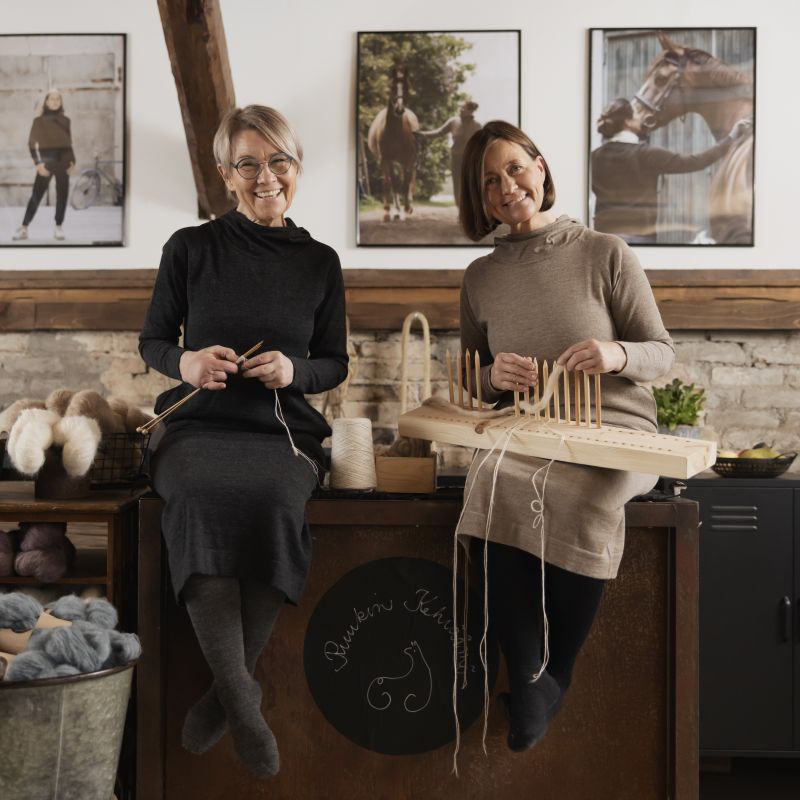
Mathildedal
Visiting hours
Open by appointment. Please call in advance and arrange a visit. We are happy to serve both individual customers and groups.
Normal opening hours from February 14, 2026.
Warmly welcome!
Contact Us
The most ecological garment is the one that is in use.
Sustainable Luxury Knitwear
We guarantee that our products will become the trusted knitwear in your wardrobe, whether you buy them ready-made or knit them yourself.
To the online store
Finnish online store
We serve our customers, both in the online store and in our store in Mathildedal.